
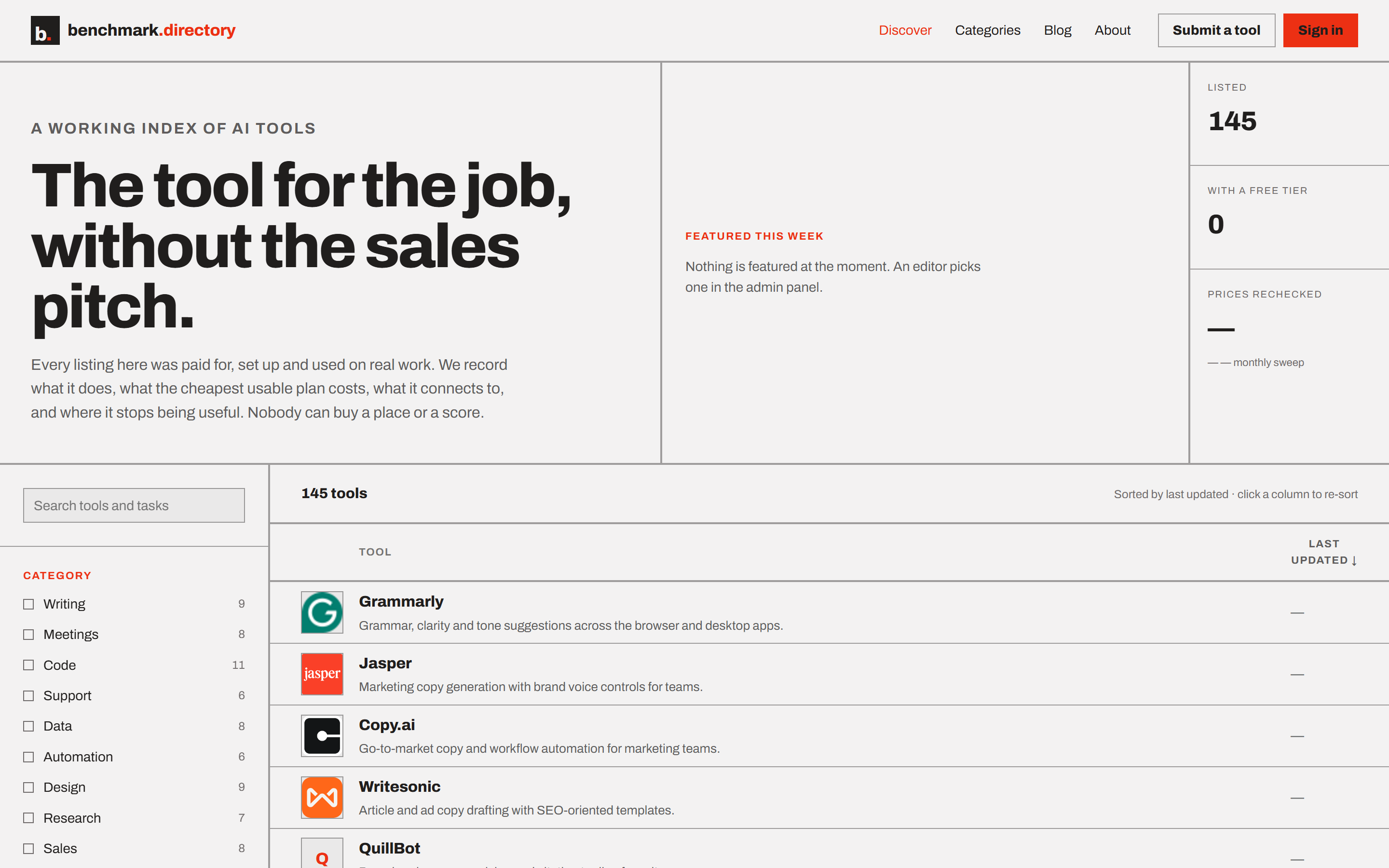
What kind of website is this?
benchmark.directory is an independent directory for discovering and screening AI tools. It organizes listings around the work people need to do rather than only around technology names. The site aims to add context that a vendor-copy aggregator usually lacks: what a tool does in practice, the cheapest usable plan, the real free-tier limits, tested connection methods, whether data is used for training by default, and the boundaries found after sustained real-work use.
Core features
- Browse AI tools by the job they support and by category, rather than only by technology label.
- Read a one-line description written by the directory instead of a direct copy of vendor messaging.
- Review the cheapest usable pricing plan and the actual limits of a free tier when those details are recorded.
- Check integrations that were tested by connecting them, along with whether work is used to train the model by default.
- Use editor scores based on setup, output quality, price to value, and support, with last-tried and correction details where available.
Common use cases
- Product, operations, and content teams can start with a work category when they need to shortlist tools for a defined task.
- Individual users can compare a tool's usable entry plan, free-tier limits, integrations, and data policy before opening a separate trial.
- Teams evaluating several options can use the directory's usage notes and editor scores when a tested listing has them.
- Researchers and practitioners can use the stated stopping points to decide whether a tool is worth deeper evaluation for their workflow.
Who is it for?
- People who want a task-oriented starting point for discovering AI tools instead of reading only vendor descriptions.
- Product, operations, marketing, and content professionals who need practical screening details before testing an application.
- Users who care about usable pricing, integrations, data-training defaults, and the limits an editor encountered.
- It is a poor fit for anyone expecting to generate content, edit media, deploy a model, or run team collaboration inside the directory; those tasks remain in the separate AI product.
How does it compare with similar tools?
Compared with directories that mainly aggregate vendor copy, benchmark.directory puts more emphasis on real-use notes, the cheapest usable plan, and recorded stopping points. Compared with review sites where every entry has a score, a submitted but not yet tested listing may have no score; the site describes that as missing information rather than a low rating. Compared with an AI application itself, it is a discovery and evaluation reference, not the place where generation, editing, integrations, or collaboration happen. The site also states that vendors cannot buy placement, ordering, or score influence.
Frequently asked questions
Q: Is benchmark.directory an AI tool itself?
A: No. It is a directory and evaluation reference; the listed applications provide the actual generation, editing, or other work.
Q: What information does a listing include?
A: Depending on the listing, it can include the tool's use, cheapest usable plan, actual free-tier limit, tested integrations, data-training default, editor score, and the limit reached during use.
Q: Do all listings have an editor score?
A: No. A maker-submitted listing can appear before an editor tests it, so no score means the test is missing rather than that the tool received a low rating.
Q: Can a vendor pay for a position or score?
A: No. The site says there is no sponsored placement, affiliate ordering, or paid tier that lets a vendor influence placement or scoring.


