
What website is this?
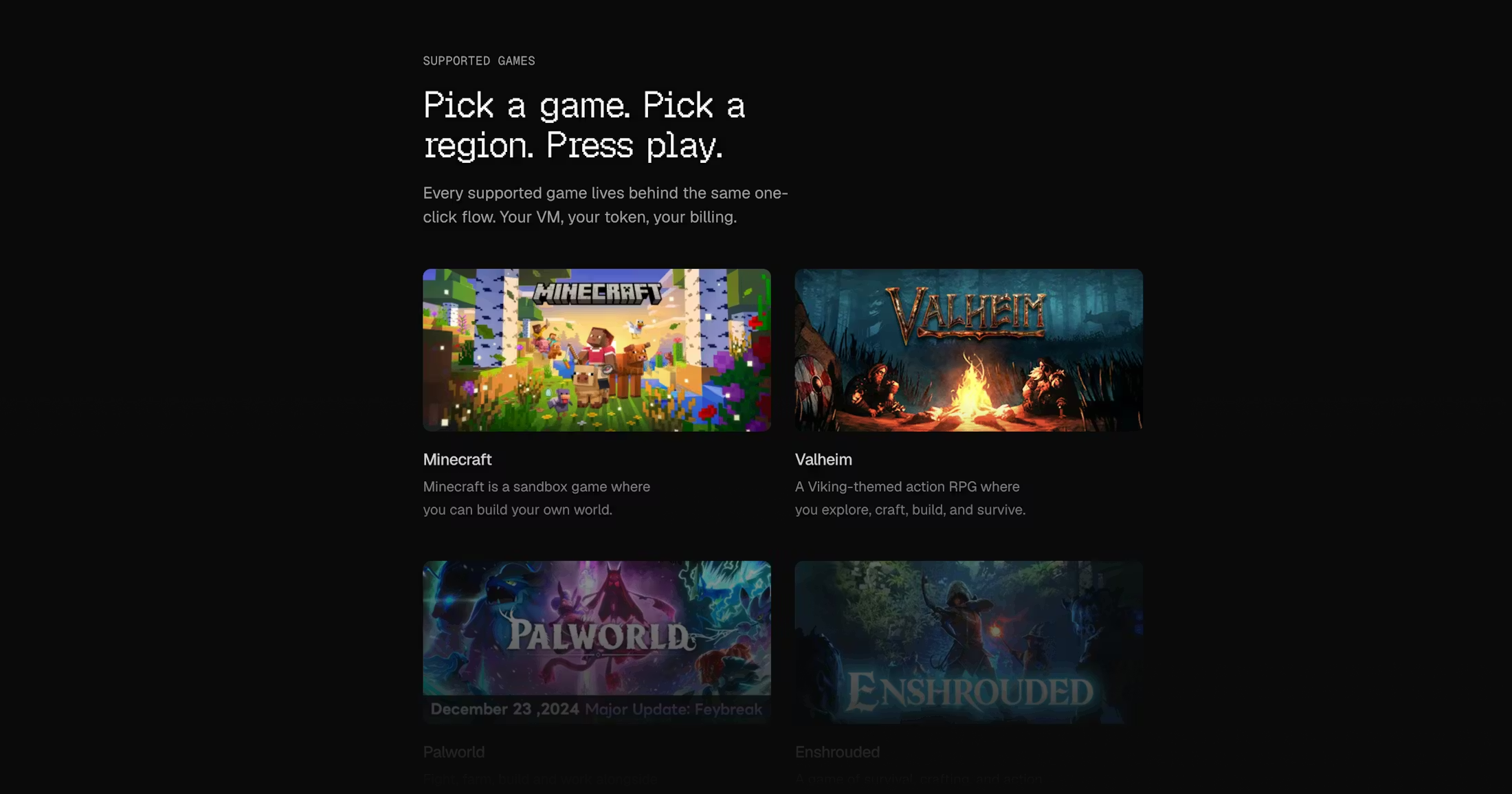
Ghost (useghost.sh) is an open-source control plane for provisioning dedicated game servers: you bring your own Hetzner Cloud account and API token and pay the VM bill yourself, while the product follows one flow to spin up containerized dedicated servers for Minecraft, Valheim, Rust, Palworld, Enshrouded, Terraria, and other titles listed on the home page. The project states the full stack is on GitHub; the browser UI exposes container stdout and a filterable activity timeline, while Docker, SSH, and firewall steps are folded into opinionated defaults—useful if you want a fast path inside a cloud account you control without writing scripts from scratch.
Key Features
- Creates dedicated servers for multiple games through a similar flow, cutting per-title documentation churn.
- Connects your own Hetzner API token to create and manage VMs inside that cloud account.
- View container output in the web UI and run common server commands from the same surface.
- Activity timeline records start/stop/restart and configuration changes for troubleshooting and shared review.
- The home page claims a healthy server can come up in about a minute on the default path (actual time depends on quotas and network).
- Control-plane code is published on GitHub for inspection or self-hosting.
Use Cases
- A steady squad runs modded Minecraft in a European region: one operator keeps the shared Hetzner token, brings an instance online quickly, and shares console access with maintainers.
- Friends schedule Valheim or Enshrouded sessions without buying a third-party “one-click” package—toggle dedicated servers under your own cloud invoice.
- Technical players already budgeting on Hetzner want fewer hand-written Compose files and firewall rules, using the panel to centralize logs and recent actions.
- Community admins compare routes: bundled pricing from a managed host versus transparent cloud billing plus Ghost-style orchestration and customization headroom.
Who is it for?
- Individuals or small teams who can open or already use Hetzner Cloud and responsibly manage API tokens.
- Players who want the same kind of setup steps across several supported titles instead of rebuilding a bespoke panel each time.
- Users who treat publicly readable GitHub source as a prerequisite for trusting the control plane.
- Not ideal for people committed to non-Hetzner clouds or home hardware without changing environments; anyone who refuses to touch cloud accounts or tokens and prefers a single hosted vendor to handle everything.
How It Compares to Similar Tools?
Commercial game hosting often merges instance and panel charges on one invoice; Ghost behaves more like an orchestration layer: VM charges stay on Hetzner, while the control-plane code remains visible. Compared with DIY scripts alone, it trims manual Docker, SSH, and firewall wiring but couples you to one cloud vendor’s path. If you must span multiple clouds or bare metal, verify what the repository supports first; if your goal is zero cloud-account involvement, traditional managed packages are usually simpler.
Pricing Details
No public price table appeared on the home page; fetching /pricing redirected to a sign-in flow, so any separate software fee or subscription (if present) needs to be confirmed inside the authenticated product. Compute, storage, and traffic are always billed by Hetzner according to your usage and are independent of whether the platform charges for software—follow the latest terms and pricing shown on the site or in your account.
FAQs
Q: Does Ghost only work with Hetzner?
A: The home page centers on bringing your own Hetzner Cloud API token; if you do not use that vendor, check the repository for other backends—public messaging is Hetzner-focused.
Q: Is “servers in about a minute” guaranteed?
A: Copy describes a fast default path; first-time provisioning can still be shaped by quotas, image pulls, and regional load—validate with your own run.
Q: What if my game is not on the list?
A: The site points to opening a GitHub issue for roadmap consideration; delivery timing depends on maintainer schedules and should not be treated as a promise.
Q: What does it cost overall?
A: Cloud resources bill through Hetzner; whether the platform adds fees requires logging in—the home page lists no public numbers.
Q: How is this different from buying managed game hosting?
A: Managed hosts frequently bundle billing and ops; here VM charges remain on your cloud account while the product emphasizes orchestration and panel capabilities—ownership boundaries differ.
Q: Where do I verify the open-source claim?
A: The site states the stack lives on GitHub; self-hosting scope and steps belong to the repository docs.
Q: Can total beginners skip Linux entirely?
A: The panel reduces manual Docker and firewall work, but API tokens and basic cloud-console literacy still matter—users


