
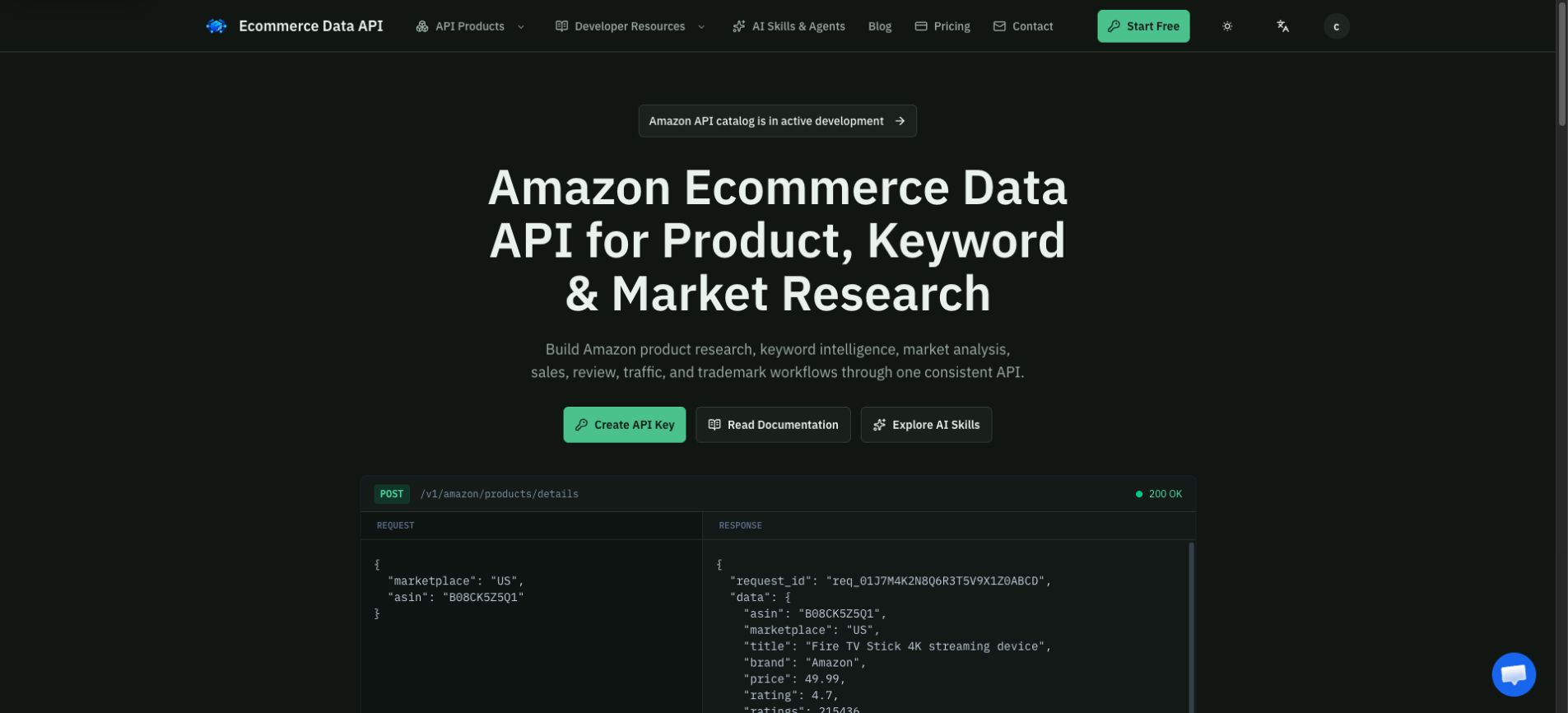
What is this website?
Ecommerce Data API is a third-party ecommerce research data service. Its current public coverage centers on Amazon: product listings, keywords, category markets, related traffic, and reviews, plus global trademarks, Chinese and Latin text in images, and Google search-interest curves. Official seller APIs cover orders and inventory inside your own account. This site fills in research fields on any ASIN and returns JSON, so you do not parse the page yourself. The homepage says the Amazon endpoint catalog is still being developed. Unit sales, search volume, and revenue are model estimates. They can be compared within the same period, and they are not transaction figures published by Amazon.
Core features
- Product detail accepts one ASIN and returns the title, price, offers, main-category BSR, subcategory ranks, star rating, rating count, written-review count, seller, fulfillment method, variation list, and listing quality score. Marketplace codes include US, JP, UK, DE, FR, IT, ES, CA, IN, MX, BR, AU, and AE. There is no UPC or EAN parameter, so a barcode has to be turned into an ASIN first.
- Keyword research returns estimated monthly searches, purchases, purchase rate, competing-product count, supply-demand ratio, and a suggested bid range for a marketplace, month, and keyword. You can filter by search volume and word count, drop brand terms, and then sort. A
yyyyMMvalue formonthlooks back up to 24 months;nearlymeans the last 30 days. - Sales data is split into three endpoints: daily and monthly units and revenue by ASIN, parent and child monthly trends by ASIN, or a conversion from category BSR. Child unit sales on the trend endpoint are integer bands. When no estimate is available, the API returns
422and does not bill that call. - Market analysis covers category size, product and brand concentration, price bands, ratings, and demand trends. Traffic analysis covers related products, traffic sources, and keyword flow.
- Trademark endpoints can search a list, read a record, and show registration-status counts plus the countries and offices covered. Image text recognition accepts an image URL, Base64, or a file upload.
- The production base URL is
https://ecommercedataapi.com, and the public version isv1. Authenticate withX-API-KeyorAuthorization: Bearer, one of the two. Keys can be revoked. For direct users, rate limits, concurrency, and credits are totaled per account; extra keys do not add quota.
Common use cases
- Someone choosing a product first builds a table of monthly searches, purchase rate, and competing-product counts from the keyword endpoint, then pulls Google Trends. Each interest score is scaled so the peak is 100. Read the shape of the curve. Do not subtract scores from two separate queries, and do not treat the score as Amazon sales.
- Someone running a competitor board pulls price, BSR, rating, and offers for the same ASIN each day. Records include
updatedTime. Product pages also note that rank can move between snapshots. - Someone reading a category uses market statistics for concentration and price bands, then sales estimates to order the leading ASINs. The same BSR in two categories is not comparable. When a whole category cools, rank can stay put while estimated sales drop.
- Someone checking a brand before listing uses the trademark list and detail to see registration status, then decides whether that name can go in the title. Rankings are a separate path: each board is a snapshot on the date shown. The first 20 rows are public. After login, up to 100 rows are available and can be exported as CSV.
- A seller who only wants inbound shipments, orders, and ad reports for their own store will not find post-authorization operating data here. That data sits in the Amazon Selling Partner API and the Advertising API.
Who is it for?
- Developers who need Amazon research fields in a backend, a scheduled job, or a data pipeline. The docs include OpenAPI, Postman, and copyable request examples, and they also mention subscribing through RapidAPI.
- Operators and analysts who build keyword lists, monitor competitors, and judge stocking levels without maintaining their own scraper.
- People who want to describe a task in Codex, Claude Code, or Cursor and then fetch data. The developer docs describe that path as a local
ecomdataCLI plus a Skill, and they state that no public MCP server is installed. Product pages, including the product-detail page, say these endpoints are already exposed as remote MCP tools. Check the docs open at integration time. Both paths share the same key and credits. - People who need affiliate links are closer to the affiliate Creators API (formerly the Product Advertising API). People who need sales from their own account should use the Selling Partner API. The site states that it is neither of those official APIs.
- Teams that need sales written as audited figures or as an external commitment are a poor fit. The methodology page says sales, revenue, and search volume in the rankings and APIs come from third-party estimates.
How does it compare with similar tools?
On the Amazon side there are at least three different paths. This site's docs split them by whose products you need to look up, not by rank.
The affiliate API is for product links. It covers the public catalog and does not provide BSR history, sales estimates, or listing quality scores. Access requires an affiliate account. The Selling Partner API is for authorized sellers and vendors. It can manage your own listings, inventory, and inbound shipments. For someone else's ASIN it offers limited catalog information and the current rank. Ecommerce Data API uses an API key to query any ASIN across 13 marketplaces. The fields lean toward research: variations, quality scores, keyword estimates, market distribution, and sales models.
Against writing your own scraper, you get fixed JSON, one error body, and per-call credits. Coverage is whatever the catalog includes. The homepage says 45 endpoints are open: 12 for products, 11 for keywords, 14 for markets, 3 for traffic, 4 for trademarks, and 1 for image text. A request body over 64 KB returns 413. Do not retry a parameter or auth error unchanged.
Pricing is by call count, not by seat. Monthly subscriptions come in three tiers: 900 calls at about US$9, 3,500 at about US$29, and 13,000 at about US$79. Unused calls expire at the end of the month. Annual billing charges once, but credits are still issued monthly. One-time call packs last 60 days. Published prices run from 50 calls at US$1.99, 600 at US$6.99, and 1,500 at US$13.99, to 8,000 at US$69.99. The blog says a new account gets 5 test calls after email verification, valid for 24 hours, with no long-term free quota. One successful billable request currently costs 1 call unless that endpoint's docs say otherwise. 402 means the balance is insufficient. 429 means the rate or concurrency limit was exceeded.
FAQ
Q: Is Ecommerce Data API Amazon's official product API?
A: No. The site says the official product API is for affiliate links, and the Selling Partner API manages your own seller account. This service returns BSR, variations, listing quality scores, and sales estimates. The credential is an API key.
Q: Can sales and search figures from the API be treated as completed transactions?
A: No. Both the keyword and sales pages say these are estimates, useful for comparing terms or products and for reading direction. Child sales on the trend endpoint are bands. 422 means this input has no estimate; retrying will not produce a number.
Q: How are credits consumed, and how do call packs differ from subscriptions?
A: All public endpoints share one balance. Subscriptions issue calls monthly, and unused calls expire at month end. Call packs are a one-time purchase valid for 60 days. A successful billable call generally costs 1 credit. ASIN_NOT_FOUND, INVALID_PARAMETERS, and PAGE_NOT_AVAILABLE are not billed. The usage page keeps a redacted request body and up to 20 KB of the response for 7 days.
Q: Are direct API access and the AI agent two different datasets?
A: No. The docs say both share the API key, credits, and the same set of v1 REST endpoints. On the agent side, a local CLI and Skill choose the endpoint. After the online catalog changes, you do not need to reinstall the Skill. Some product pages also claim a remote MCP. Whether you use MCP depends on the documentation open when you integrate.


