


What Is This Website?
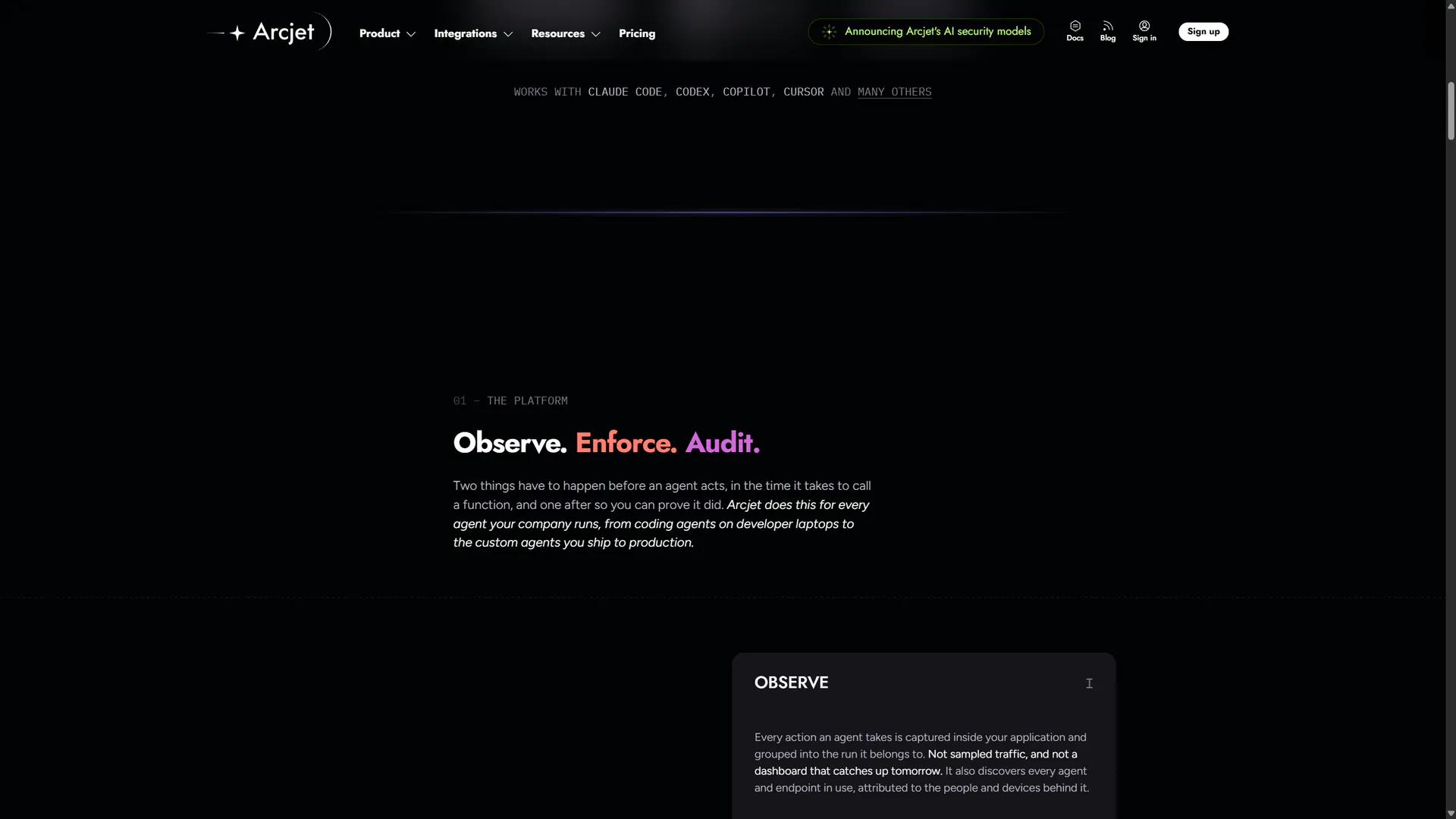
Arcjet is a runtime security tool for engineering and security teams that run AI agents. Inside application code, a coding-agent hook, or an endpoint agent, it checks an action that is about to happen and returns allow, deny, redact, or hold. Checks cover prompt injection, tool calls, sensitive information, and spend limits. Compared with a gateway that only sees network traffic, it can see function arguments and earlier steps in the same run. It fits teams whose agents already call tools, databases, or actions that move money.
Key Features
- Return allow, deny, redact, or hold before an action runs.
- Check user input and tool output for prompt injection.
- Limit tools and MCP calls by identity, role, and arguments.
- Cap tokens and spend per user, organization, or single run.
- Store the decision and policy version, and send them to an external log system.
Common Use Cases
- Before a refund or an outbound email, an application team allows or blocks the call by role and amount.
- A security team inventories coding agents on developer machines and blocks MCP servers that are not yet approved.
- A platform team sets one shared quota for an agent run so a loop cannot exhaust the budget.
- A web team checks bots, disposable email, and WAF rules on the same signup endpoint.
Who Is It For?
- Engineering teams that call tools from production AI applications.
- Security teams that want one policy and a record of each decision.
- Companies that use Claude Code, Cursor, or Codex and need to limit what those agents can reach.
- If you are looking for a chatbot or a writing tool, this product does not provide that.
How Does It Compare?
- If a decision must see the arguments about to be passed to a tool, Arcjet sits in the code path rather than only at the network entrance.
- The site says it can sit beside an external gateway: the gateway handles discovery and routing, and Arcjet enforces inside the app.
- If you cannot change code and cannot install the macOS or Windows endpoint agent, the public pages do not describe a fully out-of-band deployment.
Pricing Details
The pricing page lists Individual at $25 per month and Startup at $299 per month, both with a 15-day trial. Enterprise is quoted separately. Usage fees are $5 per million web requests and $50 per million agent requests. The FAQ says that after the trial the account stays on a free plan capped at 10,000 requests per month. Going over that cap stops requests; it is not billed as overage. Individual includes 1 member and 1 hour of log retention. Startup includes 2 members and 24 hours of log retention. Prices can change; check the live site.
FAQ
Q: Does the trial turn into an automatic charge?
A: The FAQ says the account moves to a free plan of 10,000 requests per month. Over the cap, requests stop, and overage is not billed.
Q: Does every security-rule change require a new release?
A: Not always. Rules can live in code, or a remote policy in the console can take effect immediately.
Q: Is Arcjet the same kind of product as an MCP gateway?
A: Not exactly. A gateway discovers and routes outside the app. Arcjet decides inside the code that takes the action.
Q: Is there something you can install on a computer?
A: Yes. An endpoint agent for macOS and Windows discovers coding agents and applies policy. It can be deployed through MDM.
Why We Recommend?
Arcjet places the check before an action runs, so prompt injection, tool permissions, and spend limits can be handled in one place. Engineering or security teams whose agents already call internal tools can keep an audit from the same decision. You add it through code, a hook, or an endpoint agent, and the free plan still has a monthly request cap.
Sources
- Sources: https://arcjet.com/ , https://arcjet.com/pricing
- Last checked: 2026-11-10
- Note: Prices, trial length, and the free request cap follow the live website.


