

What website is this?
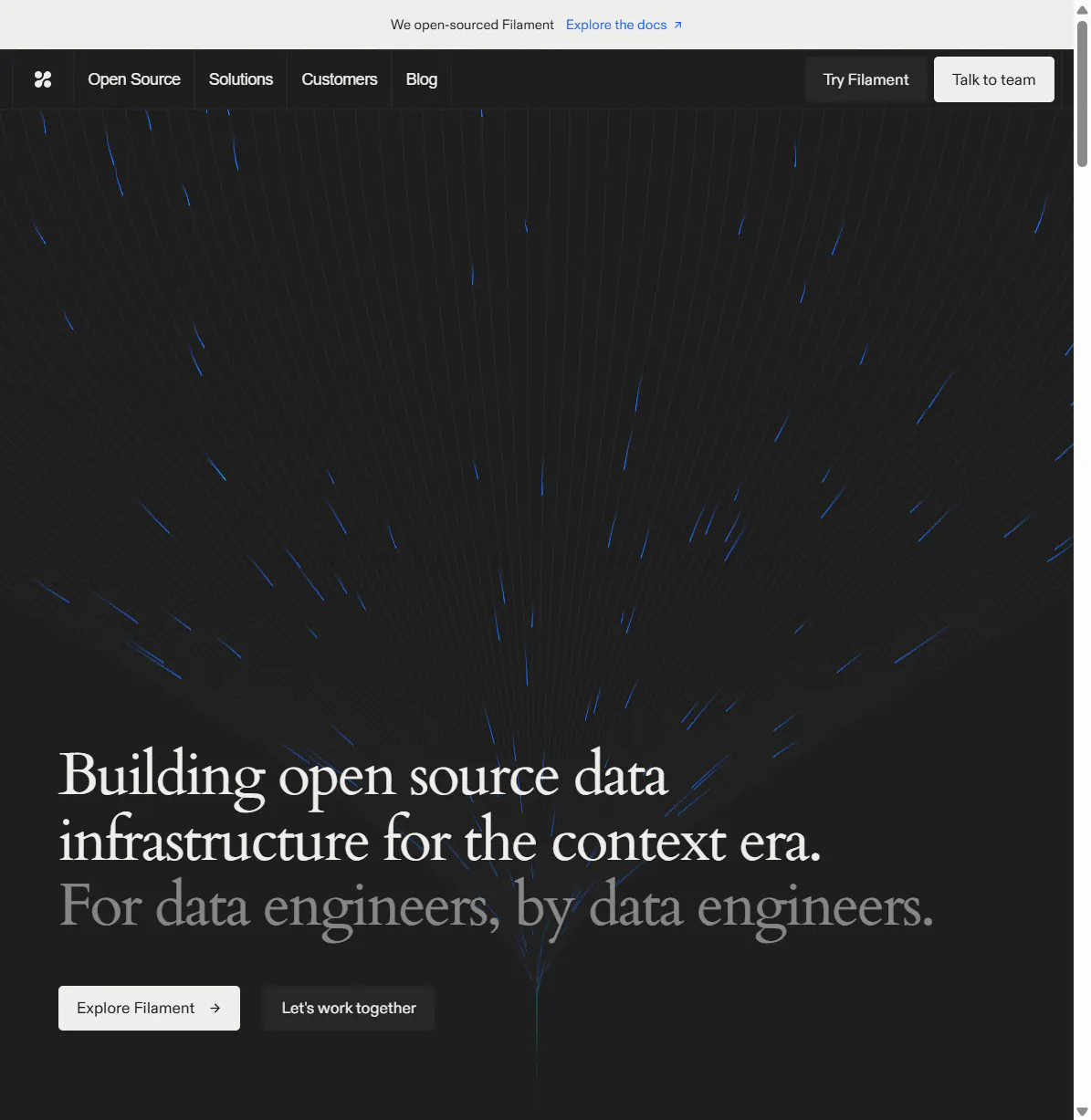
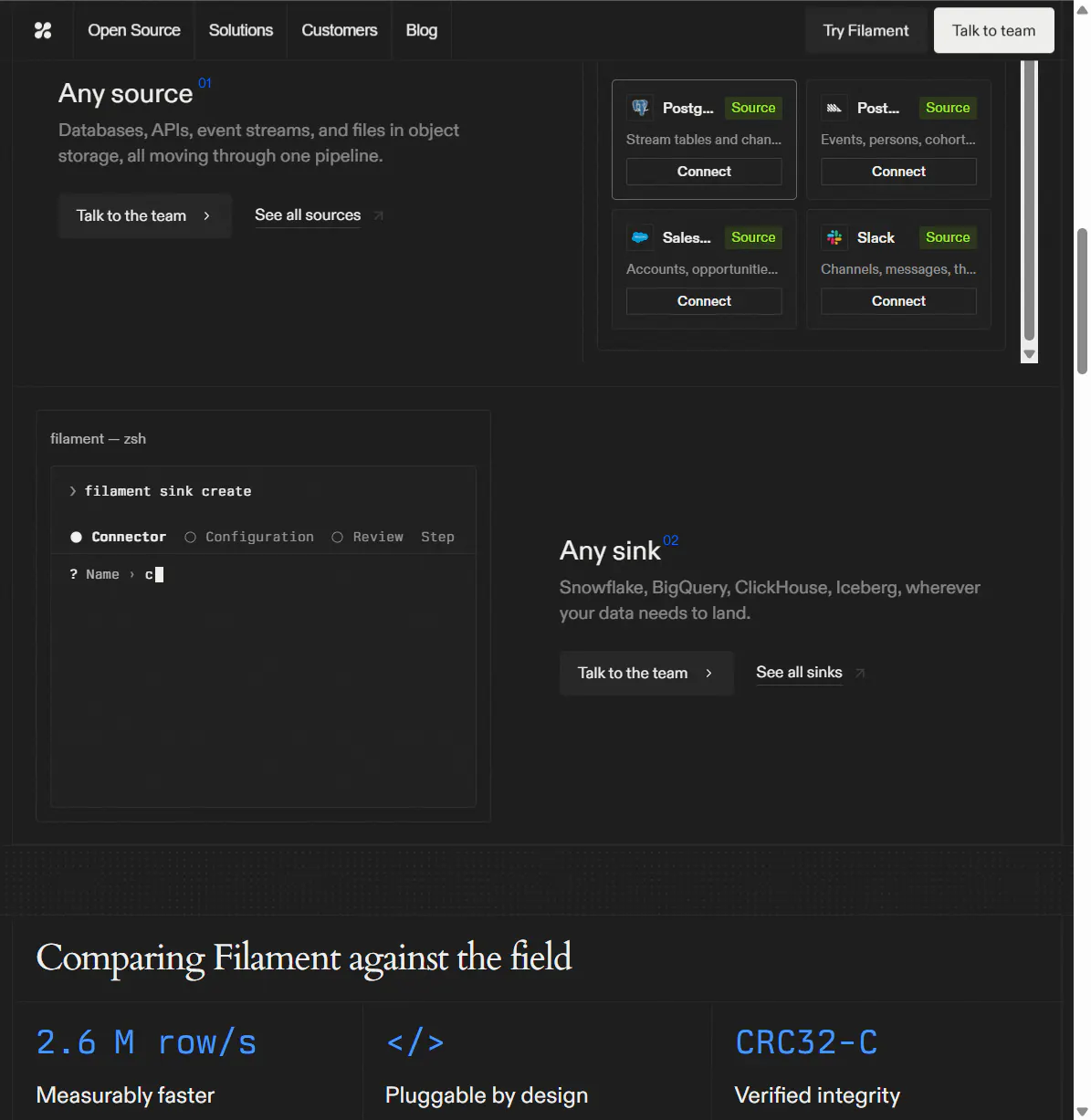
Galaxy is Intergalactic Data Labs’ data-infrastructure site, and the product it leads with is the open-source engine Filament. It pulls data from databases, APIs, event streams, and object storage, then writes to Snowflake, BigQuery, ClickHouse, or Iceberg. Unlike row-metered hosted sync, Filament is released under Apache 2.0, the docs show how to self-host it, and the product pages do not split features into a paid switch.
Key Features
- Reads data from Postgres, MySQL, HTTP APIs, event streams, and object storage.
- Writes a full load, an incremental sync, or change capture into a warehouse, lake, or database.
- The standalone program includes a web UI, and it can also be embedded in a Go service or deployed to Kubernetes with Helm.
- Checks each batch as it is written; an interrupted run continues from the last checkpoint.
- Connectors, the state store, and the event bus can be swapped without changing an existing pipeline.
Use Cases
- A data engineer keeps Postgres inserts, updates, and deletes flowing into Snowflake and skips repeated exports.
- A platform team runs replication on its own Kubernetes cluster instead of handing the pipeline to a usage-billed host.
- A team that must check row counts and checksums uses a batch check that fails closed, so bad data does not land quietly.
- A team reviews the public benchmark and docs first, then decides whether to ask Galaxy to help with deployment.
Who is it for?
- Data engineers who need change capture and plan to host the replication themselves.
- Platform teams that want both the pipeline and the runtime to stay in their own repository and cluster.
- Analysts who only want a hosted account and do not want to handle deployment will find installation and connector setup heavy.
- People looking for a ready-made semantic layer and dashboards will find the public pages still centered on the movement engine.
How It Compares to Similar Tools?
The public pages compare Filament with Airbyte, Fivetran, Debezium, dlt, and others on the same hardware and data, and the benchmark repository is public. The differences you can actually check are self-hosting, whether billing is per row, and whether checksums and resume points are built into the engine. When hosted operations and a ready-made connector catalog matter more, read those products’ own documentation. When you need an engine you can take with you and a benchmark you can rerun, look at Filament. The pages do not give market share or an independent third-party ranking.
Pricing Details
The Filament page says you can start for free and that usage is not metered. The announcement says the engine has no paid feature gate. The Apache 2.0 repository can be deployed on your own. Galaxy’s terms took effect on 2026-02-02 and say the cloud service may charge by subscription or order, but the public site does not list plan names, monthly fees, or usage prices. Deployment help and custom work require contacting the team, and the amount is whatever they state.
FAQs
Q: Does Galaxy’s Filament cost money?
A: The engine page says Apache 2.0, no volume metering, and no paid feature gate. The terms mention a cloud subscription fee, but the site publishes no price list.
Q: Can Filament capture database changes?
A: The docs cover full loads, incremental sync, and change capture, with Postgres and MySQL to warehouse examples. Supported scope follows the connector docs.
Q: Does the Galaxy team have to deploy it?
A: No. The docs include a standalone program, Go embedding, and a Kubernetes recipe. Contact them when you want them working in the repository with you.
Q: Can the speed numbers on the homepage be treated as a ranking?
A: They are Galaxy’s own published benchmark, including about 2.6 million rows per second on the taxi test. Read them together with the method and the raw results.
Why We Recommend?
Filament puts replication, verification, and resume-from-checkpoint into one engine you can host yourself, so the data does not have to pass through a row-metered pipeline first. For data engineers who need ongoing table sync on their own cluster, the path is fairly direct. It does not operate the connectors for you, the cloud service has no public price list, and you still need to read the deployment docs before going live.
Information sources
- Source pages: https://www.getgalaxy.io/ , https://www.getgalaxy.io/filament , https://filament.getgalaxy.io/ , https://www.getgalaxy.io/blog/introducing-filament , https://www.getgalaxy.io/legal/terms-of-service
- Last checked: 2026-11-14
- Note: Prices, connectors, and benchmarks follow the latest pages on the official site and in the docs.


